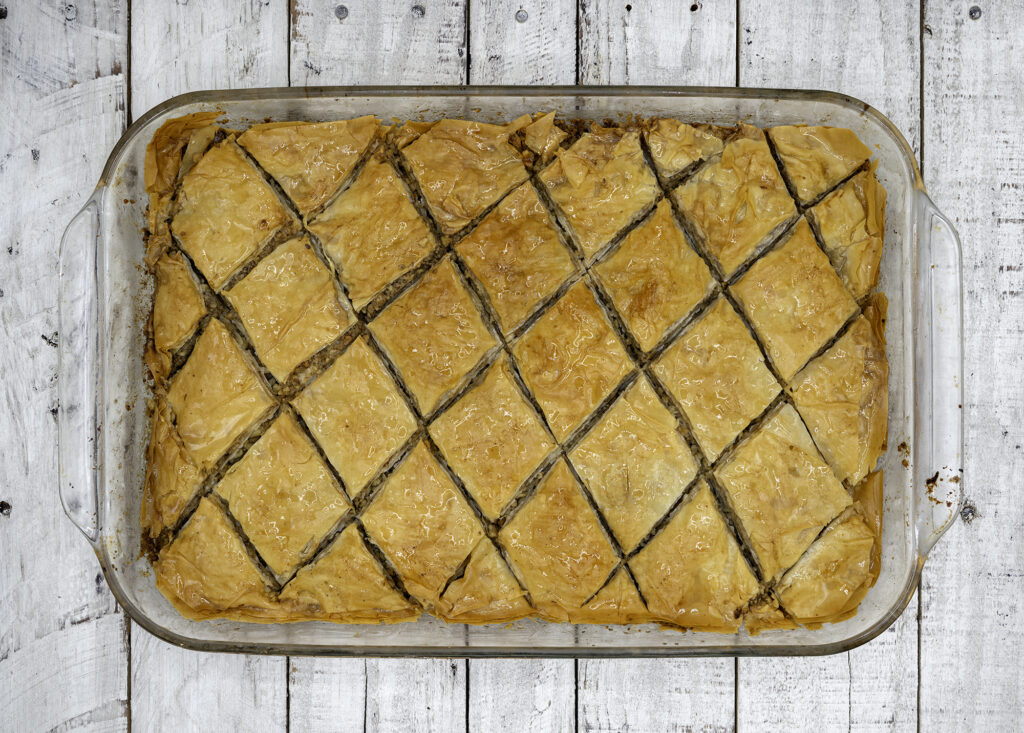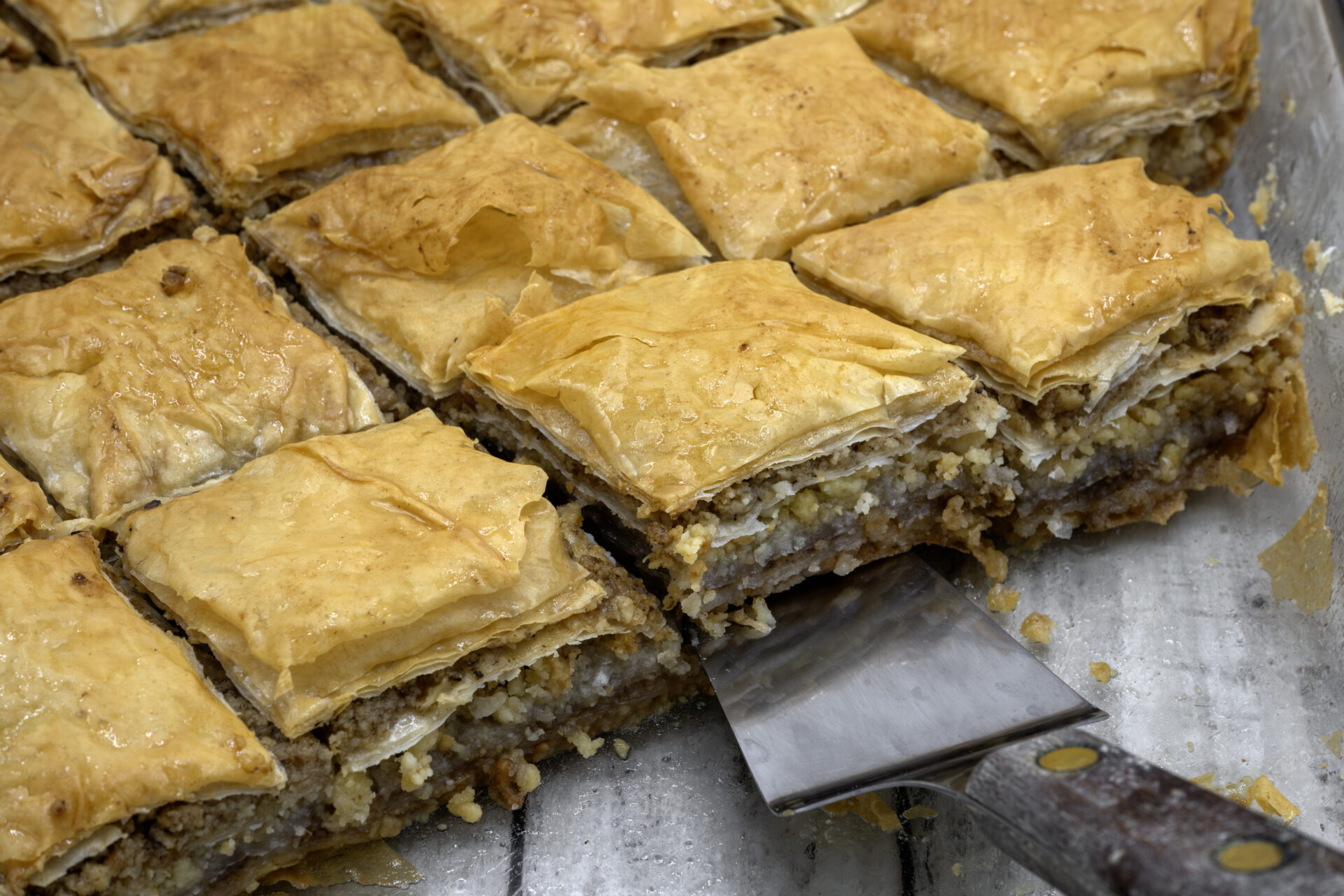
Baklava is one of my favorite desserts (you may remember my infamous baklav’amann from years back). Its uncertain origins lie somewhere between Central Asia and Greece, probably in Turkey. In its current form, a recipe is first documented in the kitchens of the Topkapı Palace, where the sultan offered portions of baklava to the janissaries during Ramadan. While the ingredients are easy to find, it is undoubtedly the elaborate assembly of multiple layers of phyllo dough, both crispy and saturated with sugar, that gives it its distinctive prestige.
The dessert eventually spread through every level of society and throughout all the countries that once experienced Ottoman rule. Each region has its own version of baklava nowadays, made with pistachios or walnuts in Turkey and the Middle East, almonds in the Maghreb, and walnuts in the Caucasus and the Balkans. Some variations add rarer ingredients such as jasmine, cardamom, saffron, rose water, or orange blossom water. Note that outside of Greece and the Maghreb, baklava contains no honey.
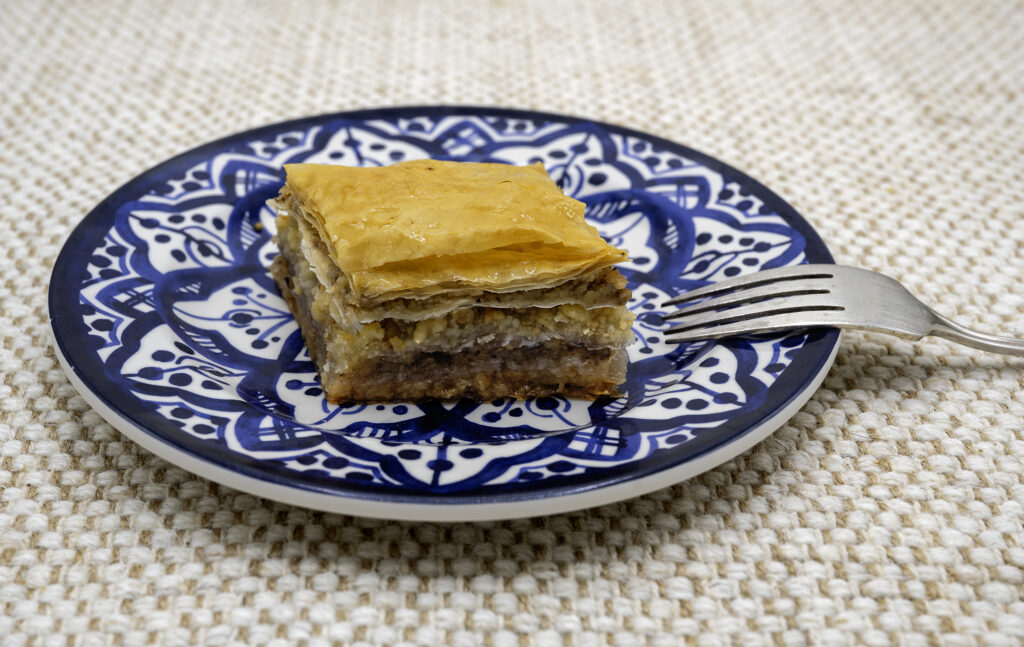
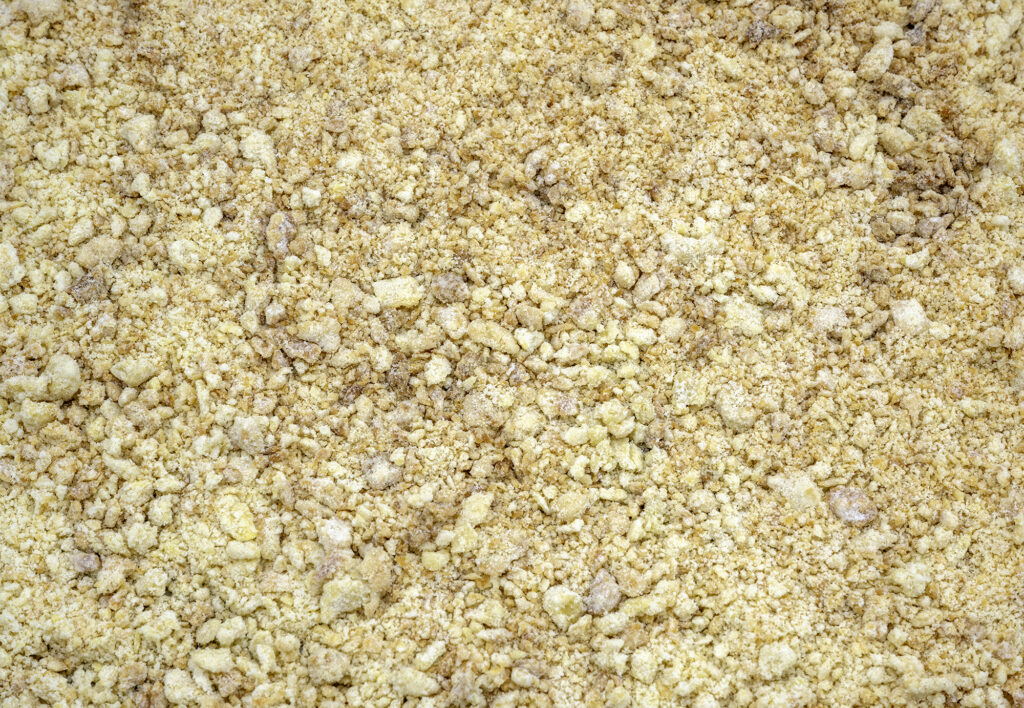
In Bosnia, a very sweet syrup called ağda, sometimes flavored with spices and citrus, is poured over the phyllo dough after baking. In the so-called Sarajevo version, the walnuts alternate with layers of tirit (a Turkish word referring to food that is soaked), a kind of streusel that imitates their crunchy texture, balances their bitterness, and absorbs the torrent of syrup. My recipe differs little from those found in Bosnian cookbooks, but it includes precise quantities and instructions, and an ağda with subtle aromas. If you’re familiar with this blog, you might think I’m going to tell you to make you own phyllo dough. Nope! The truth is, store-bough phyllo is thinner than anything you can achieve at home, and just as good.
Sarajevo Baklava
Yields over 20 servings
Total preparation: 4 hours
Active preparation: 1 hour
Tirit
480 g AP flour
2 g salt
120 g butter, diced
95 g (about 2) eggs, beaten
- Sift the flour into a bowl, and stir in the salt. Add the butter, and rub into the flour using your fingertips. Pour the beaten eggs over the mixture, and combine with your fingertips to form small but homogeneous lumps of dough.
- Transfer to two baking trays lined with parchment paper, and bake in a 200 C / 400 F oven until golden, about 12 minutes, stirring with a spatula around midtime.
- Take the trays out of the oven and let cool, crumbling any remaining larger pieces between your fingertips. Store the tirit in an air-tight container. It can be kept at room temperature for a day.
Ağda
650 sugar
2 cloves
375 g water
25 g lemon juice
12.5 g orange blossom water
- Put the sugar, cloves, and water in a saucepan, bring to a boil, and cook on medium-high heat for 5 minutes, stirring regularly.
- Remove from the heat, and mix the lemon juice and orange blossom water into the sugar syrup. Keep warm and proceed to assembly.
Assembly
350 g ground walnuts
240 g butter, melted
26 sheets (about 650 g) of phyllo dough, each measuring at least 24 cm x 34 cm
540 g tirit
ağda, warm
- If you can’t find ground walnuts, you can grind walnut halves in a food processor or a blender. Proceed in small batches, and pulse the nuts on high speed several times. Do not process for too long; you want to avoid turning them into a paste. It’s OK to have a mix of finely and more coarsely ground pieces.
- Grease a 24 cm x 34 cm baking dish with a little bit of the butter. Making sure your work surface is perfectly dry, cut the phyllo sheets to the size of the dish.
- Place one sheet at the bottom of the dish, and brush with melted butter. This extra base sheet will help prevent the bottom from getting too soggy. You’ll be brushing every sheet of phyllo dough with butter, so pace yourself. Don’t use more than approximately 9 g of butter each time.
- Stack 5 more sheets into the dish, brushing each one with melted butter, and then sprinkle evenly with half of the tirit. Stack another 5 sheets of phyllo, each brushed with a little melted butter, and then spread half of the ground walnuts on top.
- Repeat the whole previous step with the remaining tirit and walnuts, separated again with 5 phyllo sheets brushed with butter.
- Place the remaining 5 phyllo sheets on top, still brushing each one with melted butter.
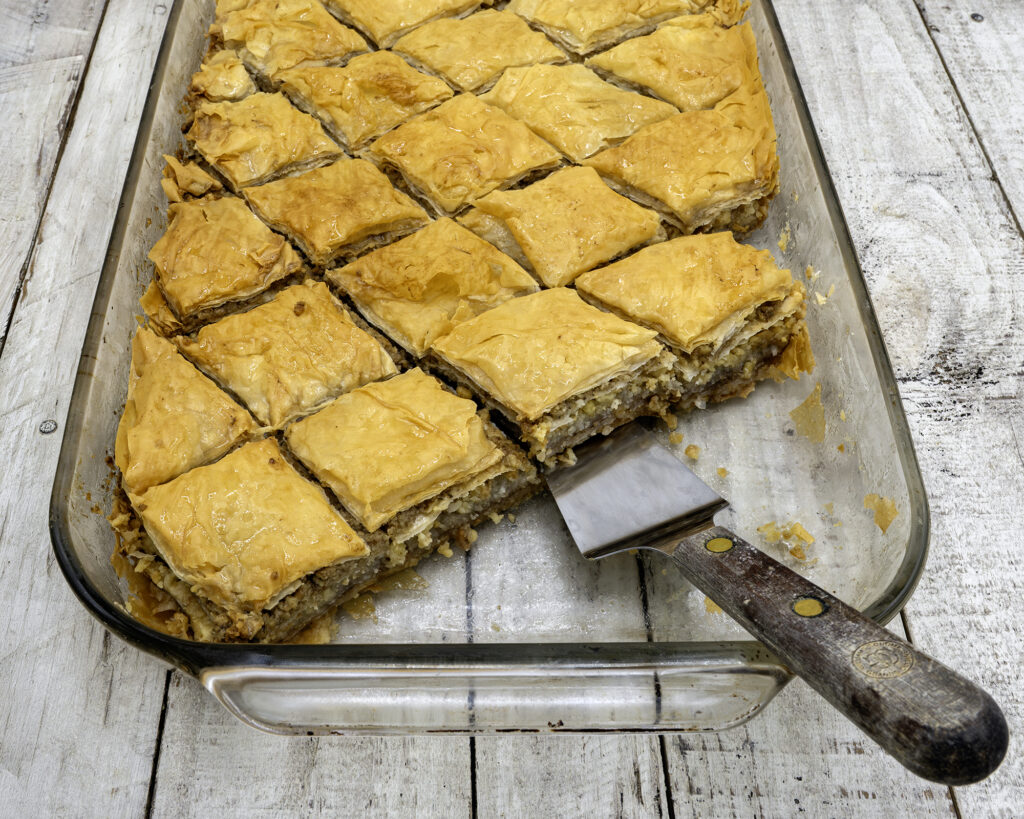
- Use a sharp knife to cut the baklava into a diamond pattern, leaving about 6 cm between the cuts, then cover with any remaining melted butter.
- Bake in a 175 C / 350 F oven until the baklava is golden-brown, 35 to 40 minutes, rotating the baking dish around midtime. Starting at the 35-minute mark, check on the baklava every 2-3 minutes to monitor doneness. Remove from the oven and let cool 5 for minutes.
- Discard the cloves from the ağda, and pour over the baklava. Let rest at room temperature until the baklava absorbs all the syrup and cools completely, at least 2 hours.
- Cover with foil and store at room temperature. The baklava tends to become soggier over time and should be consumed within three days.