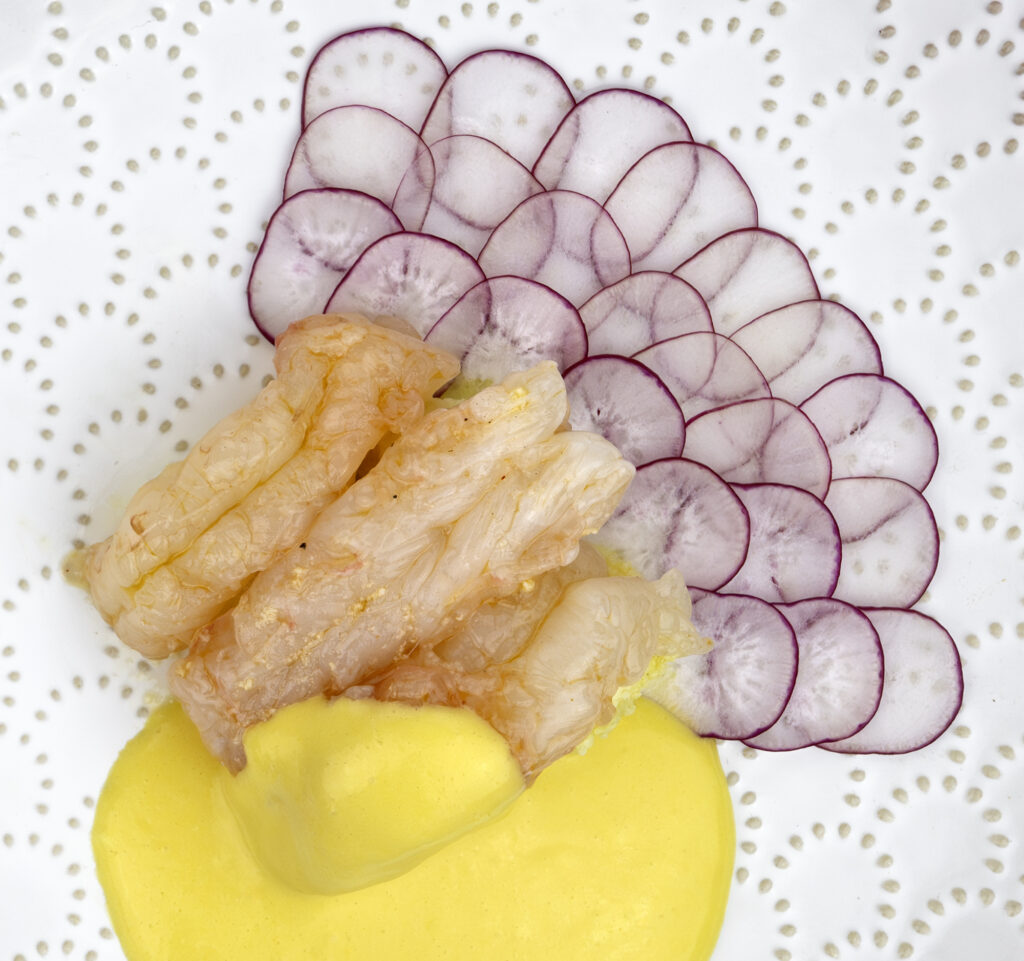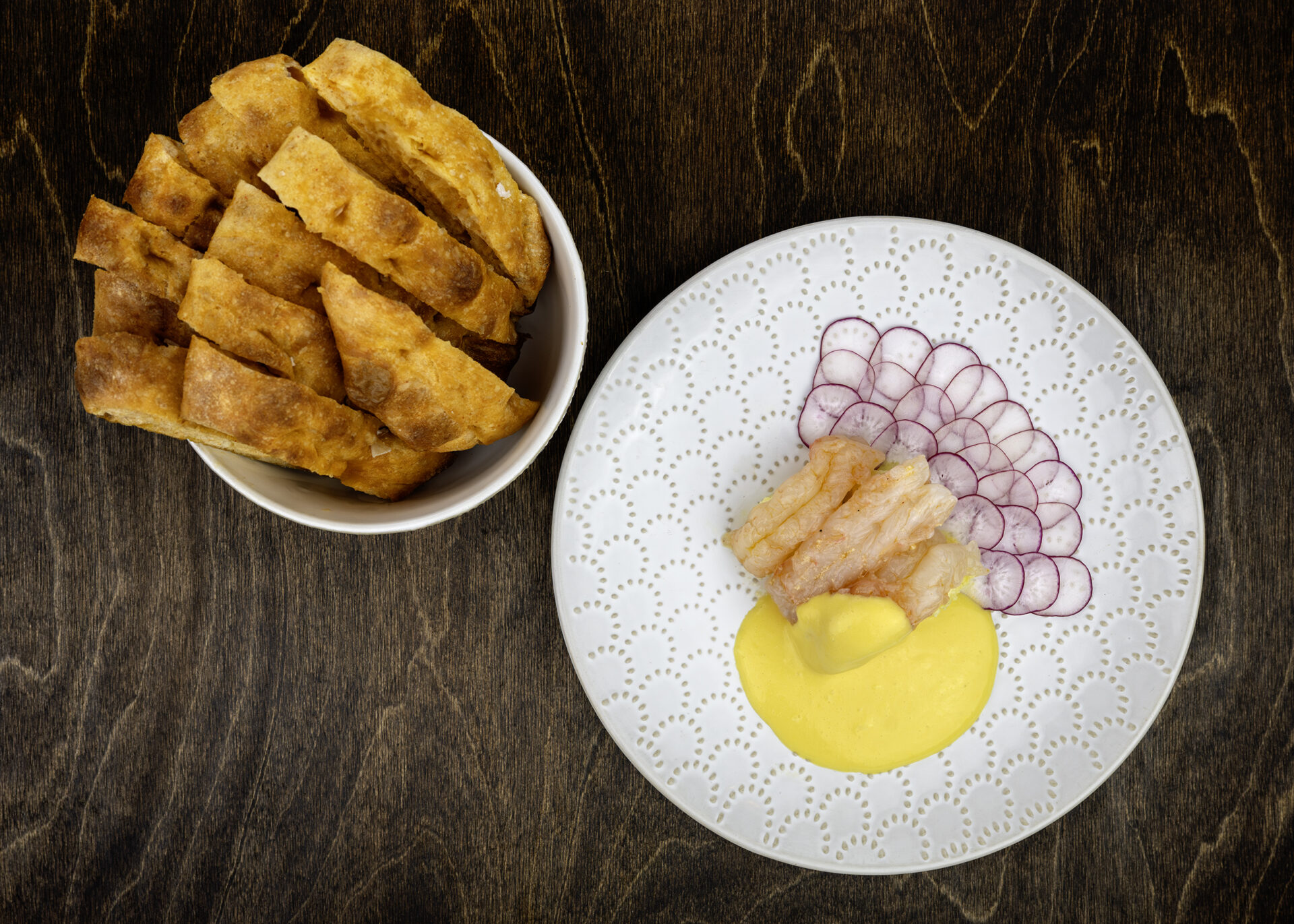
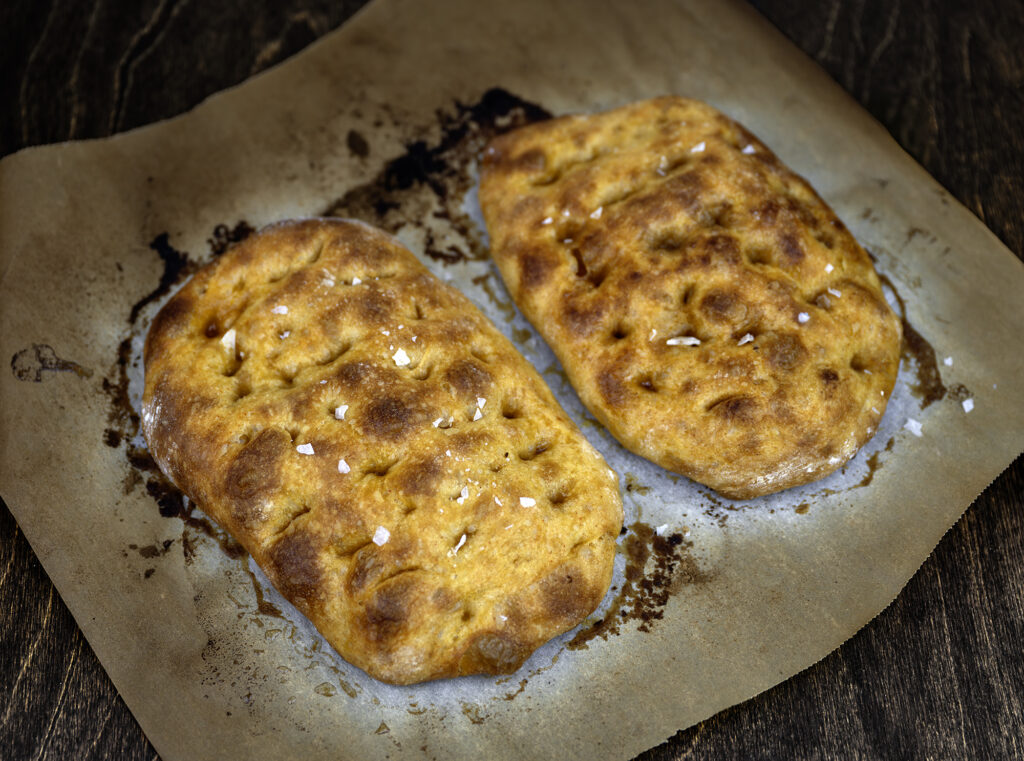
To follow the pattern established on these pages, time has come to create a recipe inspired by my meal at Draga di Lovrana. Although the review wasn’t exactly flattering, a couple of dishes still hit the spot, such as the marinated langoustines with skuta (farmer cheese), lemon emulsion, olive oil, and honey. I’ve decided to produce a version of that dish with only minimal changes, as langoustines don’t need any elaborate preparations to shine. My focus has been on making a rich, tasty lemon sauce, and I opted to marinate the skuta in a blend of olive oil and honey – exactly as I prepared it in my previous post (what a coincidence). Still, considering how ridiculously expensive langoustines are, I wanted to use every bit of them. There’s always the option to use the heads, claws, and shells in a sauce or a bisque for another meal, but why not try to use them in this dish? Enter the langoustine-paprika focaccia, my adaptation of the plain focaccia from Breaking Breads by Uri Scheft, now flavored with langoustine-paprika oil. You’ll want to work on this colorful flatbread last, while the lemon emulsion is cooling and the langoustines are marinating, so you can enjoy it fresh from the oven.
Marinated Langoustines with Skuta and Lemon Emulsion
Yields 4 servings
Total preparation: 4 hours (plus 12 hours for the marinated skuta)
Active preparation: 1 hour 30 minutes (plus 30 minutes for the marinated skuta)
Langoustine fabrication
1.4 kg large whole langoustines (8-10 / kg)
- Separate the heads and claws from the tails of the langoustines. Carefully peel the tails. Discard the shells and claws, or use them for another recipe (e.g., in a sauce or a bisque).
- You should have about 260 g of tail meat and 450 g of langoustine heads. Wrap the meat in plastic film and reserve in the refrigerator. Reserve the heads for the langoustine oil. Use everything the same day.
Langoustine oil
about 450 g langoustine heads
200 g olive oil
3.5 g sweet paprika
- Cut the langoustine heads lengthwise and place in a small saucepan. Add the olive oil and paprika, and cook over low heat for 30 minutes, stirring regularly.
- Pass the oil through a chinois, pressing on the heads to extract as much langoustine flavor as possible. You should obtain about 140 g of langoustine oil. Reserve in a container in the refrigerator.
Lemon emulsion
100 g whey left over from making skuta, or 90 g water combined with 10 g milk
12 threads saffron, powdered in a mortar
4 g lemon zest
2 g sugar
50 g (about 3) egg yolks
80 g butter
9 g lemon juice
15 g langoustine oil
about 1 g salt
- Bring the whey with the saffron, lemon zest, and sugar to a simmer in a small saucepan. Let rest for 5 minutes, then pass through a chinois.
- In a double boiler over medium heat, combine the whey mixture with the egg yolks. Whisk continuously until the sauce thickens and reaches 85 C / 185 F. Immediately remove from the heat.
- Whisk in the butter in a few additions, then add the lemon juice and langoustine oil. Rectify the salt seasoning.
- Transfer to a bowl, cover with plastic wrap, let cool, and refrigerate.
Marinated langoustines
260 g langoustine tail meat
20 g langoustine oil
1.2 g salt
3 g lemon juice
- Toss the langoustine tail meat with the langoustine oil, salt, and lemon juice in a bowl.
- Cover with plastic wrap, and reserve in the refrigerator for at least 1 hour.
Langoustine-Paprika focaccias
1.5 g active dry yeast
5 g sugar
320 g water, room temperature
425 g AP flour, plus some for dusting
6 g salt
6 g sweet paprika
about 80 g langoustine oil
fleur de sel
- Combine the yeast, sugar, and about 1/10th of the water in a small bowl. Let sit for 5 minutes.
- Pour the yeast mixture and the rest of the water into a large bowl. Add the flour, and start combining the ingredients with your hands. Scrape the bowl, add the salt and paprika, and mix by hand until the dough is homogeneous, about 1 minute. Cover with plastic wrap, and let rest at room temperature for 30 minutes.
- Remove the plastic wrap, and drizzle 1/8th of the langoustine oil around the edges of the dough. Grab about a quarter of the dough, stretch it up, and fold it over onto the middle. Repeat 3 more times, giving the bowl a quarter turn between each time. Slide your hands under the dough and flip it over. Cover again with plastic wrap, and set aside for 20 minutes.
- Repeat the entire previous step one more time.
- Heat a pizza stone on the center rack of a 250 C / 475 F oven for at least 30 minutes.
- Transfer the dough to a heavily floured surface, sprinkle some flour on top, and stretch the dough with your hands to a 18 cm x 24 cm rectangle. Cut into 4 smaller rectangles of 18 cm x 6 cm.
- Place a rectangle of dough with the short edge facing towards you and roll vertically into a cylinder, pressing after each roll to flatten slightly. Transfer to a sheet pan lined with parchment paper and dusted with flour, and sprinkle the top with just a little more flour. Repeat with the remaining rectangles of dough, cover with plastic wrap, and let proof at room temperature for 30 minutes.
- Set a piece of parchment paper on a pizza peel. Place 2 pieces of dough on top, and stretch each one into a 10 cm x 20 cm rectangle. Using your fingers, make deep depressions all over the dough, like dimples. Drizzle each one with about 15 g of langoustine oil, then deepen the dimples using your fingers again.
- Slide the parchment paper with the 2 focaccias onto the pizza stone in the oven, and bake until they start to brown, about 10 minutes. Sprinkle with fleur de sel and transfer to a cooling rack.
- Repeat with the next batch of 2 focaccias, then proceed immediately with assembly.
Assembly
50 g (about 4) radishes
salt
about 250 g marinated skuta
marinated langoustines
lemon emulsion
langoustine-paprika focaccias
- Use a mandoline to slice the radishes very thinly. Season with salt, and arrange on the plates so that the slices overlap.
- In the center of each plate, place a few chunks of skuta, and top with a few langoustines. Pour some lemon emulsion so that it coats a small part of the langoustines.
- Slice the focaccias, and serve in a bowl on the side.